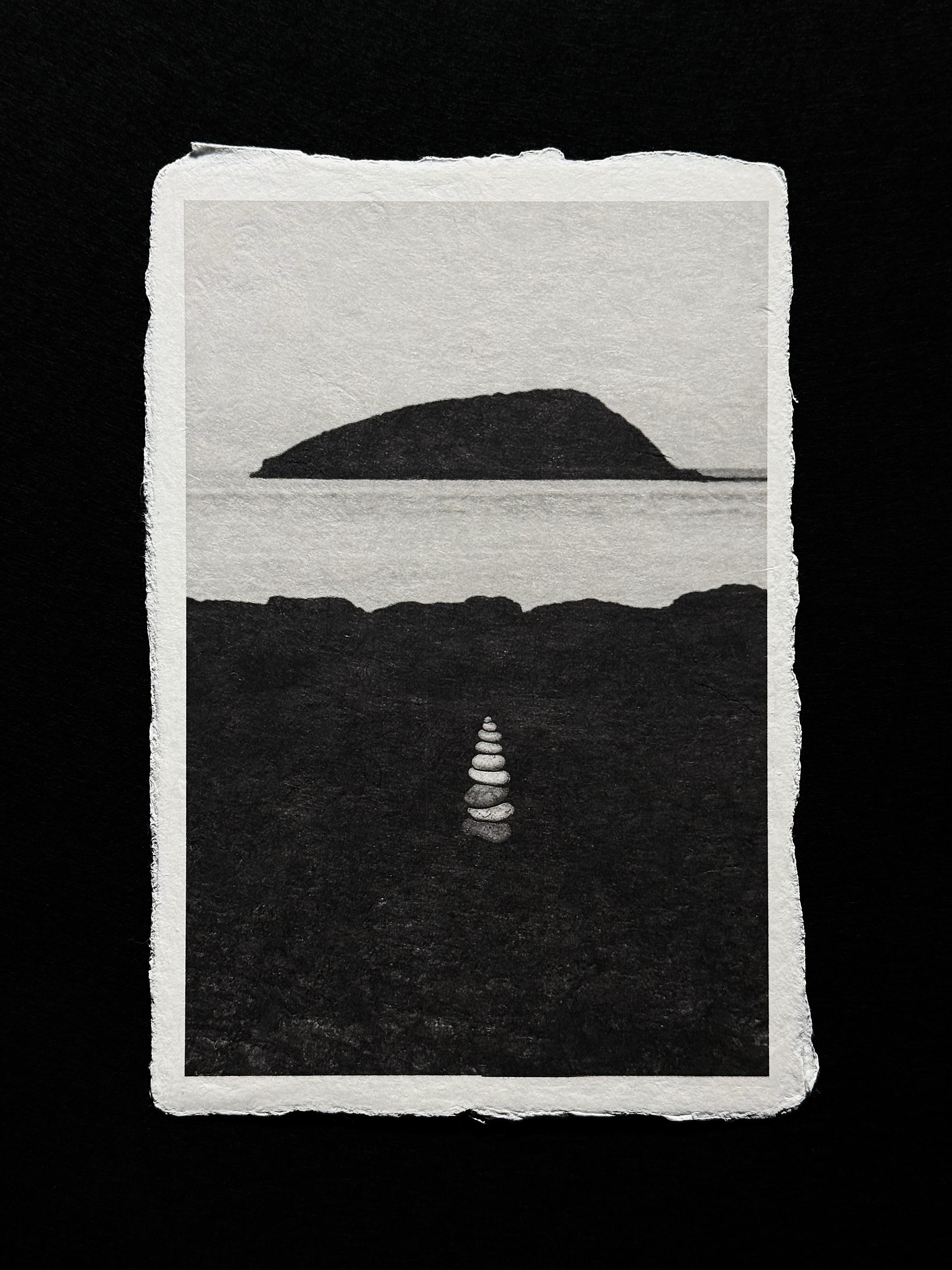
Anton Orlov’s “Morsiples,” a series of 4x5in daguerreotypes, breaks the sun’s arc into dashes and dots. Morse code.
The code in this image, says Orlov, “spells out the word daguerreotype. That was the longest and hardest exposure, which tool me 4 days to really get to where I like it, and each day 3 cameras were used. In Morse code, the word daguerreotype consists of 32 characters, and this means that altogether lens cap operation was performed a total of 768 times while only working on this one word. Should you ever try this, I highly recommend having a chair not far from your tripods.”
Samuel Morse met Louis Daguerre in Paris, only a couple months after France announced Daguerre’s invention in 1839. They exchanged sneak previews of their respective technologies then went their separate ways, into a future (I don’t think it’s an exaggeration to say) they invented.
In that future (our present), everything is coded. Images are coded. Messages are coded. Even our attention—stolen, auctioned, spun from gold into silicon—is coded.
It’s all so complicated (and not a little troublesome).
Then comes along something like Morsiples. So much effort and thoughtfulness and skill goes into a project like this. I appreciate a clever person making something clever. To that end, my first impression is a simple one, straightforward. But then I think about the planning, the process, the timing, the execution, the resolve.
Appreciation gives way to intrigue. Actually, I’m dumbfounded. Again, all that labor and craft for a coded representation of an easily researched historical encounter between two well-known figures—i.e., the creation of a secret that isn’t a secret.
It reminds me of Craig Venter, the biologist whose team created the first synthetic cell back in 2010. His lab was criticized for not considering the ethical implications. So he coded into the cells short philosophical quotations.
Do the quotes matter? Not really. They pale in comparison to the achievement. Does the word “daguerreotype” coded into a daguerreotype solve any problem worth solving? Not at all.
But it alludes to something intensely meaningful. It refers us back to the gap between language and image. And in that gap resides an invisible history of one person’s push toward mastery.
In other words, it captures an astonishing impulse, something hardly reducible to workaday incentives, something that Orlov shares with most of history’s obsessive creators: a drive to forgo assurances and comfort in favor of art.
It’s almost impossible not to compare the implications of the previous coding I mentioned (re: markets, etc) and this. The first, if it were turned into a constellation, would appear as a cash register. It would look like cost.
The second type, re: Orlov, looks like an appraisal, a measure.
It poses questions that set me back on my heels. What have I done that can’t be explained by way of years invested? What have I built that can’t be reduced to supply or demand?
Or failing these, what good work have I corrupted in my own code? What ad banner have I traded my own mystery for?