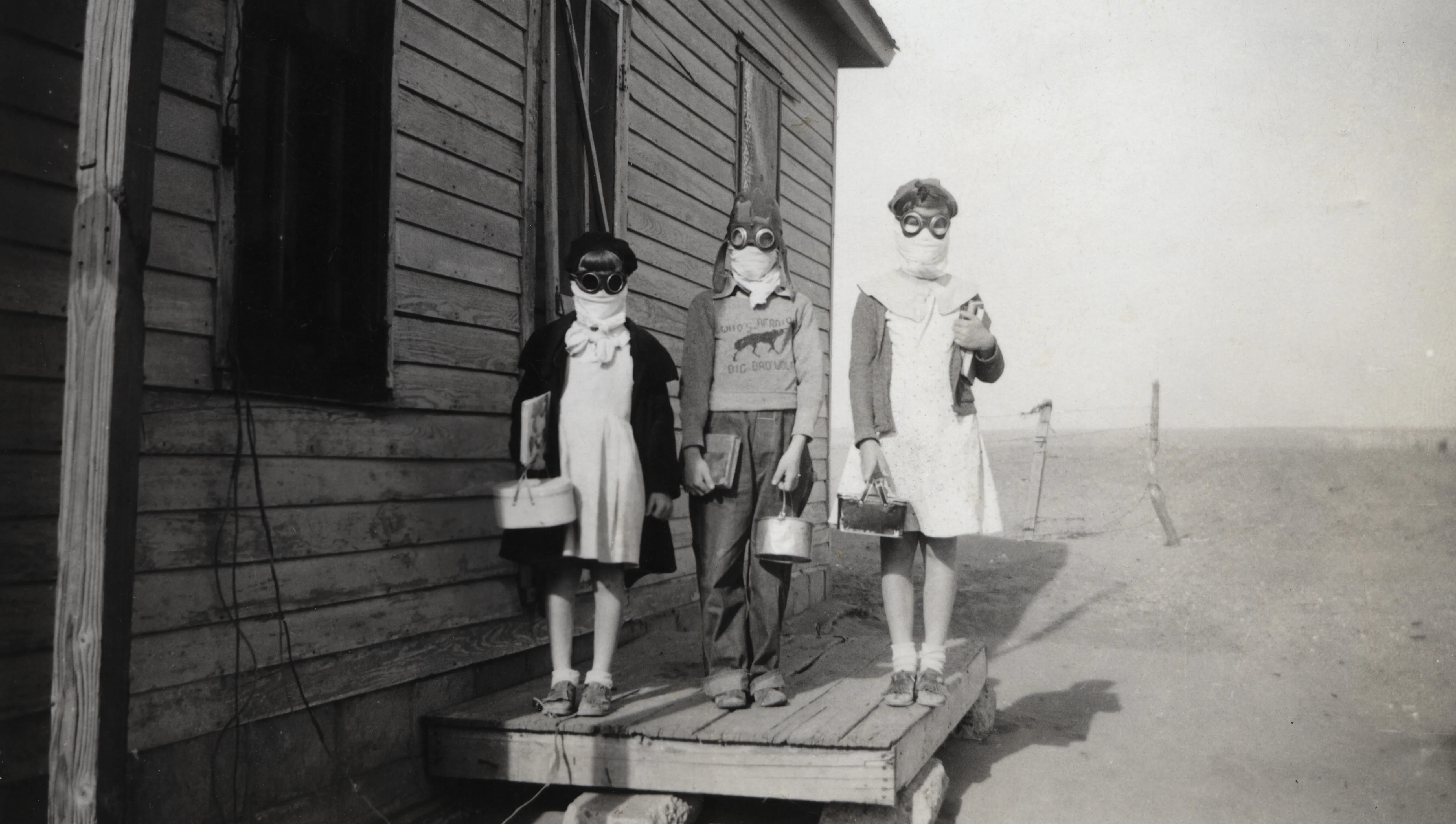
“Who’s Afraid of the Big Bad Wolf” is what the words on the middle child’s shirt say. I love a photograph with a living caption. Not that it wouldn’t have been a helluva social document anyway.
Three children stand on a doorstep, looking as put-together as you please—dresses, jackets, hats to keep their hair clean, ready for school. And where in Jung’s big Red Book does the archetype of the lunchpail appear? If it’s not there, it should be. Some things evoke childhood more than children themselves do.
But these are details the eye inventories only after the strangeness settles. I ask myself: Does it matter that I know this is a Dust Bowl photograph? Does it matter that I understand why aviator goggles and homespun shemaghs are in vogue? Does it matter—as everything written about this image post-2021 insists—that pandemics and ecological disasters connect us across generations?
It does. Mostly in academic ways though. I mean, only to the extent that it diverts bewilderment back to the comfort of certainty.
I want to stay with the bewilderment a moment longer.
The song lyrics on the middle child’s sweater are from Disney’s depression-era cartoon “Three Little Pigs,” produced just a couple years before this photograph was taken. Sung by the first two pigs who build their houses of straw and twigs, the theme of the song is que sera sera. Or, all work and no play makes Jack a dull boy.
But the third pig knows that the wolf is at the door: hunger, poverty, dust storms so high and huge, they eclipse the sun. No time for nonsense. Only hard work, only bricks.

Then I look at pictures like this one of South Dakota’s “Black Blizzard” and am overwhelmed by the apocalyptic odds. Even those bricks, what chance do they really stand against elements so comprehensive in the force and scope of their effacements?
The child with the wolf shirt and chullo seems (how to put it?) a little out-of-keeping with circumstance, not despite the protective gear but, in some ways, because of it. It’s wild to think of anyone, in troubled times like these, properly tying their shoes and whistling silly tunes on the way to school.
But tie those laces they do. And what does doing anything properly mean here anyway?
Maybe the proper way to see the human animal (for what it truly is) is to see it as a child in its actual environment, which is to say, on the front porch of Earth’s implacable hostility. Here they are, standing tall, ready to go, game.
There’s nothing in the image that separates courage from concern or diligence from play. Is it this quality or the madcap eyewear that makes the image feel so alien? One thing’s for sure: these three creatures are no extraterrestrials. They’re just another of Nature’s homegrown inscrutabilities. They wear their peril like a bad graphic. They venture, tra la la, beyond help or safe keeping. They play house with the wolf. They eat their lunch at noon.