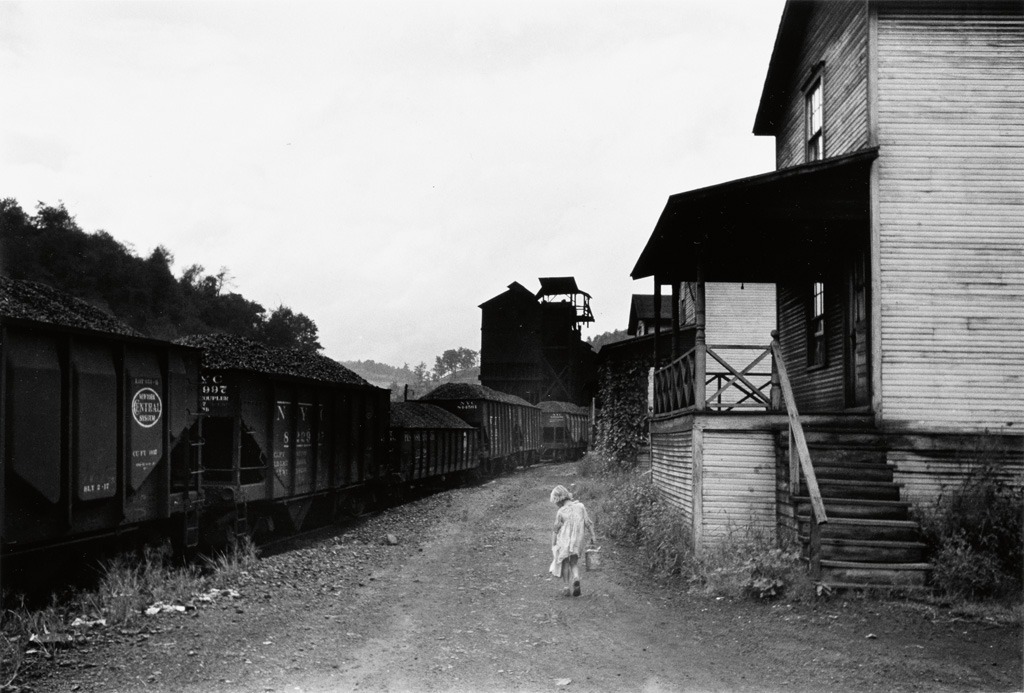
It’s 1938, the Dirty Thirties, hard times. Pursglove, Scott’s Run, West Virginia.
On the left, a coal train—a thick black wedge—cracks the image in half. On the right, company housing so void of personality, so indifferent to its own wellbeing, that no matter how hard I try, I can’t imagine it ever owning a chair that someone actually sat on or a bed with work boots by its side or a drawer with a fork or knife.
I’m not surprised (though maybe I should be) that the last thing I look at in this photograph is the black box, dead center of the image, a coal chute chucking into hoppers junk from the underworld. I suppose everything, in the end, gets pulled in that direction anyway. No need to rush it.
Not that I could if I wanted to, since Marion Post Wolcott, the eye behind the camera here, matches that immovable object with an unlikely, but irresistible, force.
A child, her whole body bent like a backwards S to keep the kerosene in her pail balanced, is forever stopped, will never make the delivery, will never step through the front door of this or any other building to help keep the lamps lit.
But there I go again, writing my odes to Grecian urns. In all likelihood, the kerosene made it home. In all likelihood, Wolcott saw to it that it did. In all likelihood, Ma kept mushing cornmeal when the girl arrived, with Pa, gone for weeks now, earning pennies in the rail yards.
What next? Another bucket. Another long haul. And then another. I have to remind myself, it’s still depression era and childhood a storybook fiction.
But that’s the point, right? With pictures like these, I mean. I don’t, I can’t, imagine Sisyphus happy, as Camus did. Neither can I make that bucket any less heavy or close the gap between me and her. But I can keep following at this distance. I can make sure I’m never any further behind than I am now.