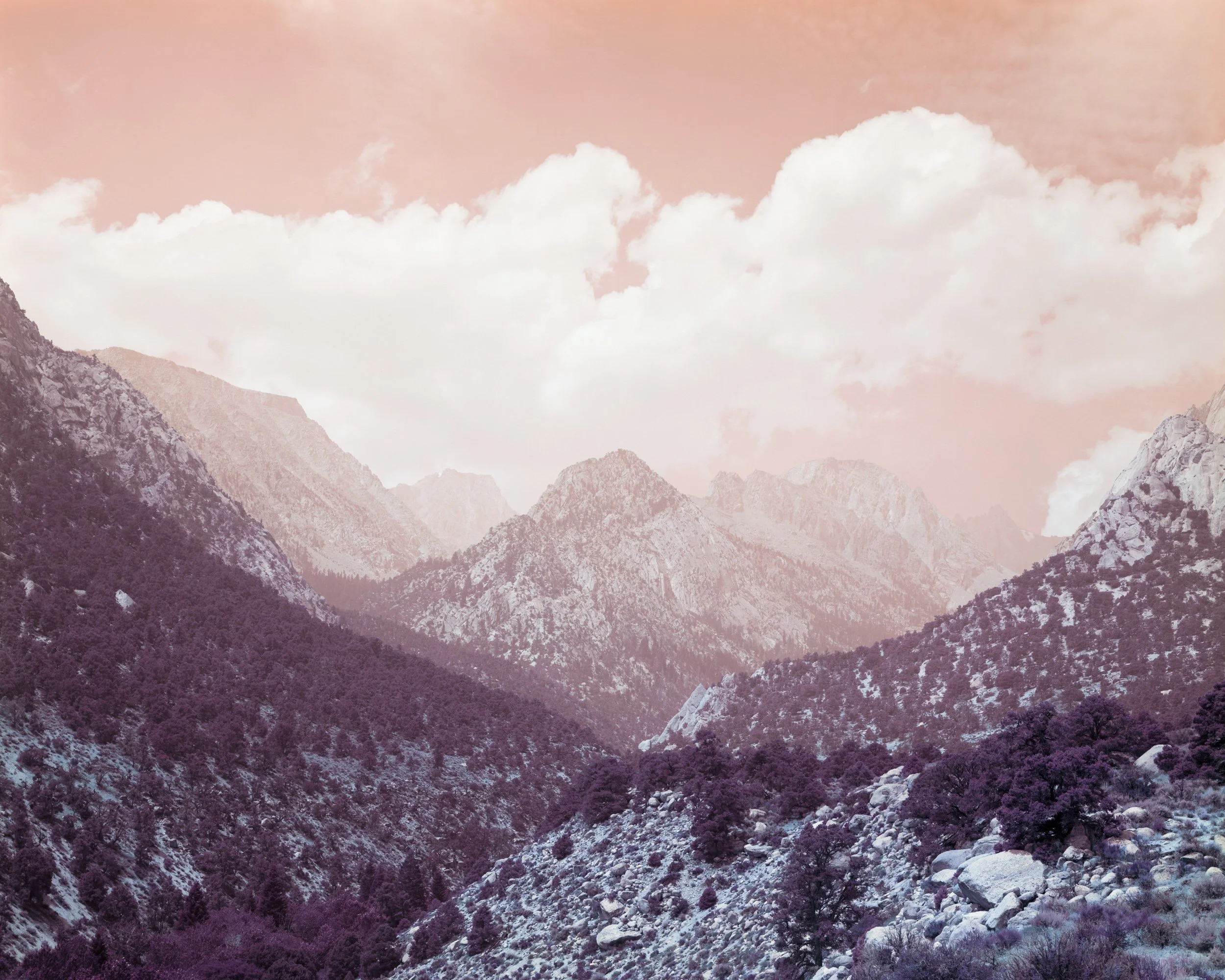
John Muir, unofficial (but surely uncontested) patron saint of the Sierra region (and the Club), once raised his arms to frame the High Sierra in his view, then wrote, “After long ages of growth in the darkness beneath the glaciers, through sunshine and storm, [the High Sierra] seemed now to be ready and waiting for the elected artist, like yellow wheat for the reaper; and I could not help wishing that I might carry colors and brushes with me on my travels, and learn to paint. In the mean time I had to be content with photographs on my mind and sketches in my note-books.”
I teach this text of Muir’s every other semester, but for whatever reason, I’ve never imagined what those hoped-for paintings might have looked like. There’s so much ecstatic romanticism in Muir’s writing about the Sierra that color and brush, even photograph and sketch, seem too—what’s the right word?—mortal to reach the mark. That it would have added something to his pleasure just didn’t seem possible to me. Until now.
Aaron Rothman’s The Sierra has me rethinking what being “content with photographs on my mind” might have meant to John Muir—or what it might mean to anyone with the same transcendental connection to, say, a river, a lake, a desert, a swamp. It might mean something like what we see on almost every spread.


What we see are familiar views made strange by inverted colors and tonal eccentricities. Initial pages like the one above, with its splashy lilac pines and skies turned chamomile tea, might feel like a contract for what’s to come. But mostly you’d be wrong.
Thin, semi-translucent insets break the sequence with images so faded they’re almost unseeable, as if they’d been left out in the rain.

And even more unexpected: chromatic shifts in the opposite direction, from Warhol to Wyeth. There are, I mean, a small number of images that remain true to nature’s palette, its ochre, sage, and slate.
Because the crucial element in Rothman’s book is surprise, these touches of verisimilitude provide the contrast that surprises need. They help the Snozzberries taste like Snozzberries.

But that’s not all that’s going on. Let’s start again where we began: Muir’s elevated tone mirrors the depth of his concerns about overhunting, overgrazing, overlogging, and oversettling the mountains and valleys he loved so much. Add to these issues climate change and overtourism—to say nothing of weakened federal and state protections largely primed by Muir in the first place—and you get a better sense of what’s actually at stake in these pages of forest confection and primeval whimsy.

The stakes, I mean, are tied to a complex dilemma: How to see anew something that’s almost impossible to see anew, how to move from seeing to caring, and how (despite the temptation to stand where Muir and Rothman have stood) to care enough to leave it alone?
Maybe it’s even more complex than that. Or maybe it’s simpler. What I can say for sure is that The Sierra doesn’t make me want to see the real thing. It makes me want to go right back to my desk and look again at every page.

Like Rothman’s The Sierra? Check out Nicolai Howalt’s Old Tjikko!