Bosch’s The Garden of Earthly Delights, the Mérode Altarpiece, the WTFness of Bacon’s Three Studies for Figures at the Base of a Crucifixion. Triptychs just have that mythic appeal. A beginning, middle, and end. A story with possibilities. Could go either way: curse or exculpation, Weird Sisters or sainthood.
Despite its long fascination for painters, the triptych rarely achieves the same staying power in photography. This may have something to do with an abiding association between the photograph and a precise moment.
Why abiding, given the suspicion all images arouse in the Age of AI? The precision of what the photograph renders exploits something thick-witted in the amygdala.
The photograph’s edges are precipitous, sheer. The vacancies between them, when sequenced or juxtaposed, are emptier somehow, somehow more abysmal, than those of paintings.
Though not a triptych, I’m thinking of Eve Sonneman’s, The Smoker (1971), where the moment between that drag of a cigarette and the exhale (vanished in the gap) might as well be a missing century.

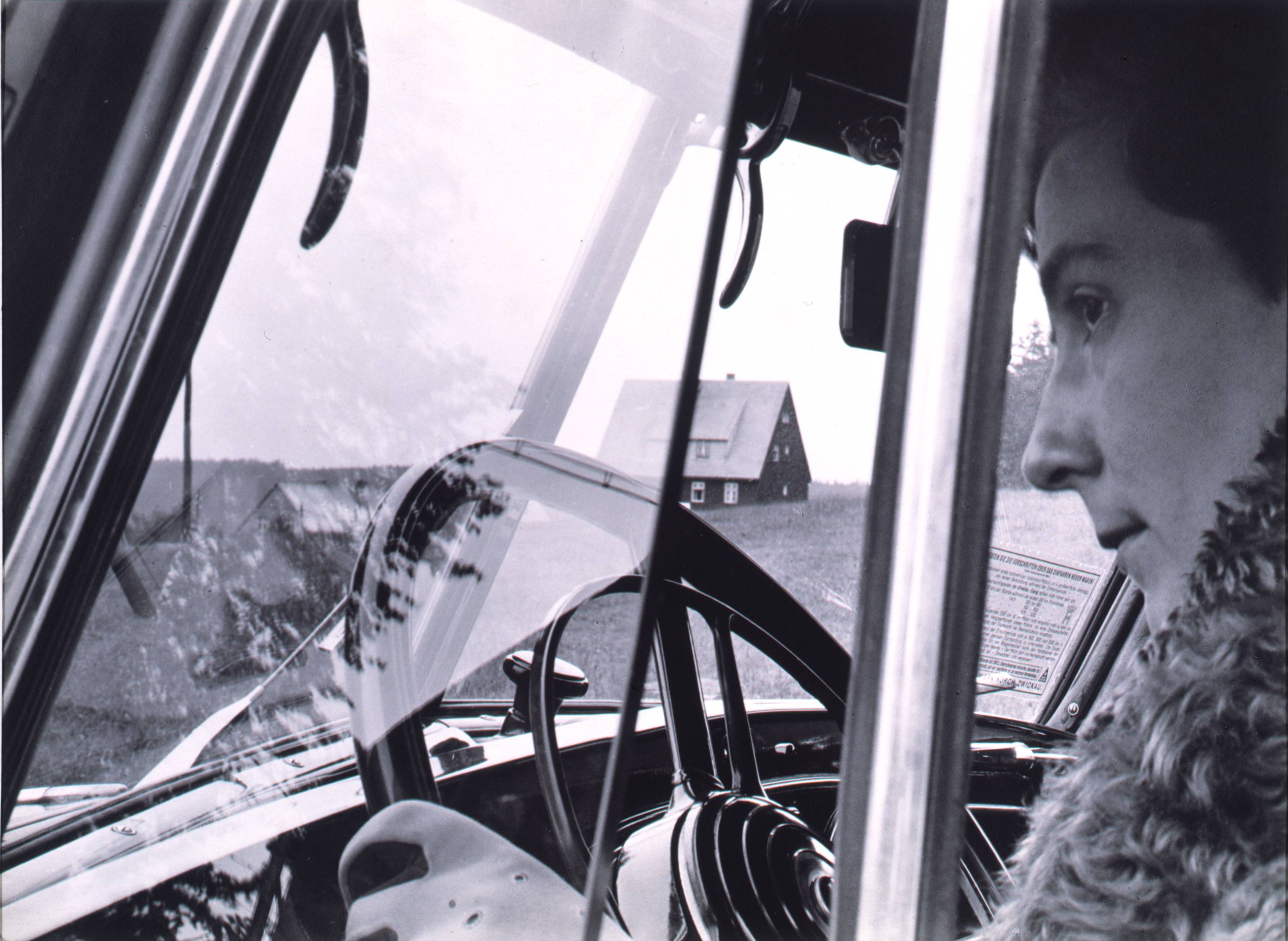
I’m fascinated, for these reasons, by the featured photograph taken by Edmund Kesting in 1930, because it’s a triptych that (for me) works. Does it work because it’s self-contained? Maybe so. But not only that.
The gist of it: Frau Kesting at the wheel, far right of the image, maybe looking both ways before turning. There’s not much else to say, except that in the distance, a house ornaments the otherwise open view.
Did I say there’s not much else?
The architecture of the car divides the scene into three distinct panels. Frau Kesting occupies the full height and width of the thin wedge to the right. A portrait.
Directly left: another thin panel, no glass. We see straight through the car. There’s the house, or half of it, and the hill on which it’s stacked. A pastoral landscape that Frau Kesting will leave behind momentarily, in the tradition of every pastoral: we’re always looking elsewhere when we’re in it, and always longing after it in the rearview.
Finally, the larger left panel of the triptych: the reflection of a scene beyond the image, illusory and surreal. There are trees in that elsewhere Neverland, maybe even a forest. But it’s not reachable. It exists on a different axis, vertically aligned against gravity.
Frau Kesting will choose a direction. Maybe turn left, maybe turn right. But the road is a stubbornly horizontal and narrow tour, and the photograph a record of misleadings.